
Our Story: How Gigawatt Coffee Roasters Started
Summarize with ChatGPT Perplexity Claude

Quick Summary
Gigawatt Coffee Roasters is a husband-and-wife air roaster in Bensenville, Illinois, started by Jen and Eli Coleman, two former private investigators, two weeks before COVID shut everything down in 2020. In Relay Commerce's Founder Stories interview, we told how one roaster in a spare bedroom and one farmers market grew into 250+ events a year.
Shannon from Relay asked us everything: how we met, where the name came from, why the bags look the way they do. Here's the story in our own words, with the full video.
Key Takeaways:
Watch the Relay Commerce interview
We sat down with Shannon for Relay Commerce's Founder Stories series on May 14, 2026. The full conversation is 28 minutes. Eli joined from one of our bean storage rooms, "the quiet place in our roastery when operations are happening."
Want to jump to a part? Launching before COVID (1:20), how we got into coffee (3:00), farmers markets (7:20), the name (12:00) and the bags (13:30).
How two private investigators ended up roasting coffee
We met at work. We were both private investigators at a small company, in two different working groups. After we worked one case together, we agreed that if we wanted our relationship to work, we should never work another job together again. (That didn't last.)
Eli traveled all over the country for work, and in his downtime he went looking for good coffee. He kept being underwhelmed. He'd come home with a $20 bag, and Jen would hide it in the pantry for the weekends. His answer: "I need good coffee Monday through Friday. I can do this cheaper and better."
When Eli was ready to leave his job, the plan was to open his own PI agency. Jen asked him if he'd be happy doing that two years from now. He said no.
"She goes, 'Look, I don't want a miserable husband. I want somebody who loves what they're doing. What do you want to do?' And I'm like, 'Roast coffee.' She looked at me like I was nuts, and six months later we launched Gigawatt."
— Eli Coleman, Co-Founder of Gigawatt Coffee Roasters
Jen's side of it: "Do I want to deal with an unhappy husband, right? When he said roast coffee I was a little surprised, but I just said, 'Okay. Find a commercial roaster, let's figure this out.'" Then she asked to be his business partner. Eli took a couple of days to think it over, and calls it "one of the best decisions of my life." His words for Jen: "she's a rock star and really the engine behind Gigawatt."

Today we split it down the middle. Eli runs the operations: the roastery, the team, hiring and the events. Jen runs the brand and the website, and the work of helping more people find us, from this blog to press and outreach.
Launching two weeks before COVID
The original plan was a café, plus selling coffee to small business offices like the one we came from. We had bought a roaster and were touring storefronts. Then, two weeks after we launched, every appointment got canceled.
"As they say, in business, timing is everything," Eli said. We crumpled up the business plan. Farmers markets were open, and we could run production from the roaster in a spare bedroom. Looking back, skipping the brick-and-mortar café was a blessing in disguise.
From a 3-pound roaster in the spare bedroom to a roastery
We're investigators, so we researched. Eli talked with roasters around Chicagoland and across the country about equipment and operations. The folks at Sputnik Coffee in Chicago gave him one piece of advice: "Get a bigger roaster or you'll regret it."
He didn't listen. We bought a 3-pound roaster, and within about 2 to 3 months we'd outgrown it. Coffee sacks piled up in the spare bedroom until we were worried about the floor joists. We upgraded to a 10-pound roaster, and by the end of the first year we'd moved into a warehouse space.
Today we run three roasters from Coffee Crafters: two 10-pounders and one 18-pounder. All three are fluid bed air roasters, a method estimated at about 1% of roasters.
Eli's way of explaining it: "It's like a big popcorn machine, just forced hot air through a chamber." The beans ride on a bed of hot air rather than tumbling against a hot drum wall, which is why we say our coffee is never bitter, never burnt. Our air roasted vs drum roasted comparison goes deeper.

You can read more about the method on our air roasted coffee page.
Why farmers markets became our home
We knew we were onto something right after our first farmers market. "The thing with live events is you get to really do market research, pun intended," Jen said. We could see how people reacted to the coffee and adjust. That first season we went from one market to about 7 a week.
A lot of coffee businesses at events are carts that sell drinks. We pour samples and drinks too, but the beans are the point.
"We really focus on the beans because we want everybody to take a bag of beans home and brew it throughout the week."
— Jen Coleman, Co-Founder of Gigawatt Coffee Roasters
Now we do 250+ events a year: weekly farmers markets, craft fairs, festivals, pop-ups and events at breweries. If you're near Chicago, our events page shows where we'll be next, and our guide to winter farmers markets around Chicago covers the cold months.

Where the name Gigawatt came from
Eli says the hardest part of starting the business was the name. We spent about two months throwing out names, a couple a day. Every good one was taken, sometimes by "some coffee company in London."
Then Eli said to Jen: "If this thing hits, we're gonna chew through some gigawatts," because we roast on an electric roaster. A light bulb went on, so to speak. When Eli texted the finalists to a buddy, he texted back two words: "Great Scott." The Back to the Future connection hadn't even crossed our minds.
"I like the blue one": why our bags look the way they do
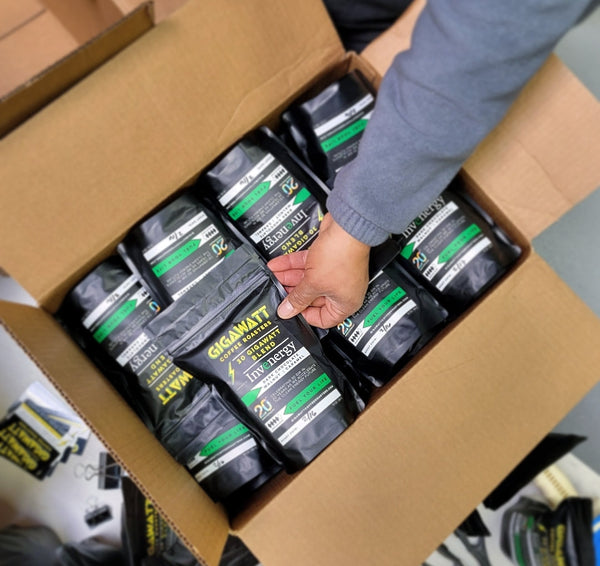
Jen designed the labels herself in Adobe, with no design background. She knew how to work with text and color, so that's what the bags are: bold text and blocks of color. The bags you see now are the second or third version.
By accident or by design, it works at the booth. People walk by and are drawn to the bags, and they remember their coffee by its color. Even customers who know the names come up and say, "I like the blue one" or "I like the orange one." That's Kite & Key and Luminosity.


Those two were the ones Shannon already knew by name. You can see the whole lineup in our shop.
Keeping beans on the shelf through the tariffs
Shannon asked about the hard lessons, too. For Eli, it was the supply chain. When tariffs on green coffee came out of left field, we had already pre-booked a lot of our coffee ahead of time, so we weren't stuck buying on the open market at tariff prices.
It still got tense. At one point, coffee wasn't coming in from Brazil at all because of a 50% tariff, and regular suppliers dried up. "It got down to the point where we were nail biting, you know, are we gonna have beans?" Eli said. We had bought enough in advance. The lesson, in his words: "We were vigilant before. It's made us twice as vigilant now."
Subscriptions you can skip, pause or cancel
Plenty of people meet us at a market first. After that first bag, a lot of them want coffee to just show up, so we tell people about our coffee subscriptions at every booth.
Subscriptions run through Smartrr. You save on every bag, and you can skip, pause or cancel any time from your customer portal. Smartrr wrote up how we grew subscriptions 7.5% in six weeks in their Gigawatt case study.
What's next: wholesale and the black can
Eli sees two places to grow. The first is wholesale coffee for cafés and shops around Chicagoland. The second is our canned cold brew.
"We offer something particularly unique, a black can of coffee. You know, just coffee, just water."
— Eli Coleman, Co-Founder of Gigawatt Coffee Roasters
Shannon tried one on camera. Her verdict: "That's the hero."

Rather make it yourself? Here's how to make cold brew coffee at home.
Gigawatt at a glance
| When | What happened |
|---|---|
| Before launch | Two private investigators decide to roast coffee; about two months of picking a name |
| 2020, two weeks before COVID | Gigawatt launches with a 3-pound roaster in a spare bedroom |
| About 2 to 3 months in | Outgrew the 3-pound roaster; upgraded to a 10-pound roaster |
| First season | From one farmers market to about 7 a week |
| End of year one | Moved out of the house and into a warehouse roastery |
| Today | 250+ events a year, online orders, subscriptions and wholesale, roasted in Bensenville, Illinois on two 10-pound and one 18-pound air roaster |
Frequently asked questions
Who owns Gigawatt Coffee Roasters?
Gigawatt Coffee Roasters is owned by Jen and Eli Coleman, a husband-and-wife team who are both co-founders. They worked as private investigators before starting the business in 2020.
When and where did Gigawatt Coffee Roasters start?
Gigawatt launched in 2020, two weeks before COVID, with a 3-pound roaster in a spare bedroom. By the end of the first year it moved into a warehouse. Today the roastery is in Bensenville, Illinois, outside Chicago.
Why is it called Gigawatt?
Gigawatt roasts on electric roasters. While picking a name, Eli joked that if the business took off, "we're gonna chew through some gigawatts." A friend's reply, "Great Scott," pointed out the Back to the Future connection.
How does Gigawatt roast its coffee?
Gigawatt uses fluid bed air roasting on Coffee Crafters roasters. The beans ride on a bed of hot air rather than tumbling against a hot drum wall. Air roasting is estimated at about 1% of roasters.
Where can I buy Gigawatt coffee?
Online at gigawattcoffeeroasters.com, which ships across the US, and at 250+ events a year around Chicagoland, mostly farmers markets. The events page lists where Gigawatt will be next. Cafés and shops can also buy wholesale.
What do people say about Gigawatt Coffee Roasters?
Gigawatt has 3,000+ five-star reviews. You can read them on the Gigawatt coffee reviews page.
Can I skip or pause a Gigawatt coffee subscription?
Yes. You can skip, pause or cancel a Gigawatt subscription any time from your customer portal.
Thank you to Shannon and the team at Relay Commerce for having us. If you liked this one, Eli tells more of the story in his interview with The Locals, and every article and interview about us is on our Press & Media page. The short version of who we are lives on our About page.