

The Coffee Farm That Changed Everything: Visiting Sandra Farms in Puerto Rico
Summarize with ChatGPT Perplexity Claude

Sandra Farms is the small coffee farm in the mountains of Adjuntas, Puerto Rico, where Gigawatt Coffee Roasters really began. We went back this March, more than ten years after our first visit.
Quick Summary
Sandra Farms is a family-owned coffee and cacao farm in Adjuntas, Puerto Rico, run by Israel and Sandra Gonzalez. Their tour covers how coffee is grown, processed and roasted, and ends with coffee and Apasionados chocolate on a balcony above the mountains. It's about two hours from San Juan, and tours run Tuesday to Sunday.
On our honeymoon in 2015, we drank coffee on that balcony and listened to Israel and Sandra explain how they grow, process and roast their own beans above 2,500 feet. We had no idea that visit would lead to a coffee company. This March we went back, same farm, same couple, this time with our toddler son, me five months pregnant, and a roastery that exists because of what we tasted there. Here's the story, what makes their coffee special, and why every coffee lover should make the drive.
Key Takeaways:
Who are Israel and Sandra Gonzalez?
Sandra Farms sits high in the mountains of Adjuntas, in Puerto Rico's Cordillera Central. It's a 225-acre working coffee and cacao farm owned by Israel and Sandra Gonzalez, a couple who met in the Peace Corps and settled in Puerto Rico's coffee country.
They bought the farm in 1994 and sold their first coffee in 2001. Since then they've come through Hurricane Maria, Hurricane Fiona, earthquakes, labor shortages and every other challenge that comes with farming in one of the most beautiful and unpredictable landscapes in the Caribbean.


Getting to Sandra Farms: then vs. now
When we first visited, you needed a hand-drawn map with landmarks to find the place. Sandra's directions included things like "there's going to be a dog barking on your right" and "you'll cross an abandoned gas station." This time, GPS worked the whole way.
The roads are still winding, and some sections near the top are a little rough. But most of the drive is paved, and if you're comfortable with mountain switchbacks, it's completely manageable. It took us about two hours from San Juan without stopping.


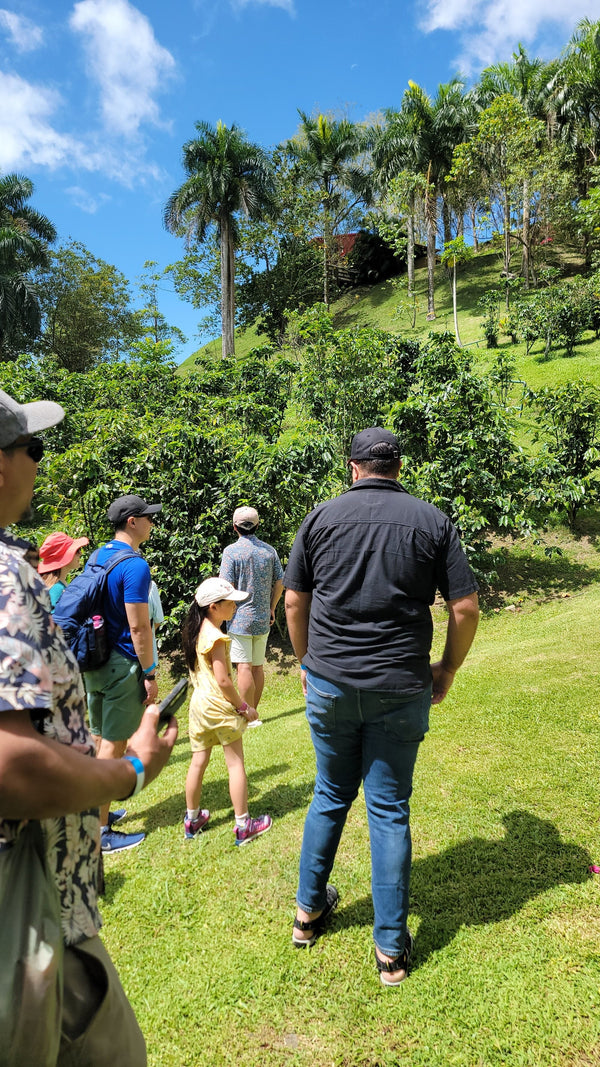
When we arrived, Israel was wrapping up a tour with a cupping on the balcony for about a dozen visitors, walking everyone through how their coffee goes from the tree to the cup. One couple was from Chicago, which made us smile. We pulled up a chair and joined in.


"The first time I tasted natural processed coffee was right here on this farm. I didn't know coffee could taste like that. I went home and bought a small test roaster and started roasting on my own."
— Eli Coleman, Co-Founder and Head Roaster at Gigawatt Coffee Roasters
What is natural processed coffee?
One of the things that makes Sandra Farms special is how Israel teaches visitors about processing. Most people don't realize that the way a coffee cherry is handled after it's picked changes what ends up in your cup.
During the tasting, Israel walked the group through natural processing and the Caturra and Bourbon varietals they grow. The samples reminded us of pink lemonade.
Sandra Farms is also working to bring back an heirloom: the Typica 401 de Puerto Rico Project, built around the Typica coffee that first arrived in Puerto Rico in 1736. Flavors like these are what the tasting notes on a coffee bag are trying to describe.

Want to taste how much processing and origin change a cup? Our single origin coffees each come from one place, and the Single Origin Sampler puts three side by side: Organic Honduran, Costa Rican Tarrazu and Mexican Chiapas.

Why fermentation matters in coffee
Israel also gave a fascinating explanation of fermentation. Within two to three hours of a coffee cherry being picked, some fermentation begins. He calls the unintended kind "careless fermentation": cherries that sit too long on the tree or wait too long to be processed develop overripe, off flavors.
What we loved was his honesty about trendy processing methods. Israel considers himself a purist. He poked fun at newer techniques like anaerobic processing, where coffee is fermented in sealed containers, sometimes with added fruit. His take: let the coffee speak for itself. As roasters who believe the best coffee doesn't need anything to hide behind, we couldn't agree more.
They didn't actually have any natural processed coffee for sale while we were there. They had just finished drying the harvest and hadn't roasted the next batch yet. That's the reality of a working farm: you get what the season gives you.
Sustainable coffee farming at 2,500 feet
Israel told us they grow their coffee above 2,500 feet without pesticides or fossil fuels, and they compost and recycle biomass. Their approach to sustainability isn't a marketing angle. It's just how they farm.

He's also committed to making coffee farming work for the next generation of Puerto Rican farmers. He wants coffee that can compete with Hawaiian Kona on quality, at a production cost young farmers can actually make a living on.
Beyond coffee: the Apasionados chocolate line
Sandra Farms doesn't just grow coffee. They grow their own cacao too, and they've turned it into one of the most unique product lines we've ever tasted. It's called Apasionados, and every flavor includes coffee from the farm.
The standout is the dark chocolate with coffee: 80% cacao, all grown on the property, with a whole coffee bean inside every piece.
Israel even has a separate roaster just for cacao. It turns at lower RPMs than a coffee roaster, because cacao and coffee beans behave differently while they roast. That kind of detail tells you how much care goes into everything they make.
Dark Chocolate with Coffee
The flagship. 80% cacao with a whole coffee bean in every piece. Rich and intense.
Turmeric & Black Pepper
Warm and earthy. Dark chocolate with coffee, turmeric and a kick of black pepper.
Ginger
Bright and spicy. Dark chocolate with coffee and ginger, a zesty bite with a smooth finish.
Cardamom
Aromatic. Dark chocolate with coffee and cardamom, fragrant and elegant.


How one farm visit became a coffee company
This is the part of the story that gets personal.
When we visited Sandra Farms on our honeymoon in 2015, Eli tasted natural processed coffee for the first time in his life. He was blown away. He didn't know coffee could have that kind of flavor without anything added. He went home, bought a small test roaster and started roasting in our kitchen.
The test roaster eventually broke, and life moved on. We were both private investigators back then. When I left to start a different career, I asked Eli a simple question one night: "Are you going to be happy doing this two years from now?"
He said no, but we'd have more money. I asked, "What do you want to do?" Without skipping a beat: "Roast coffee." And I said, "Okay. Let's find a commercial roaster."

That was it. No business plan. No focus groups. Just a memory of what great coffee tasted like, planted on a mountain balcony in Adjuntas, and a question that needed an honest answer. Today we roast on an electric air roaster in Bensenville, a method that keeps the cup clean and lets the bean's own flavor come through, the same thing Israel was talking about. If you're curious how that compares to the drum roasters most farms and roasters use, we wrote about air roasted vs drum roasted coffee. Eli tells more of the story in our interview with The Locals.
When we went back this March, Eli told Israel the full story: that their balcony was the reason Gigawatt Coffee Roasters exists. Israel and Sandra had no idea. They were genuinely moved. Sandra came home while we were there, and we all caught up like old friends. They remembered coming to our wedding, and once that clicked, the hugs didn't stop.


We sat on the balcony while a storm rolled in. The mountains disappeared into the clouds, rain hit the tin roof and the trees, and the coquí frogs started singing. If you've never heard coquí in person, it's one of those sounds that stays with you.
Our son warmed up quickly. He explored every ramp and corner of the balcony, played with a pine cone Sandra gave him and snacked on bananas and popcorn. Sandra even gave him one of her hats.
I was five months pregnant on that trip, so in a way our daughter came along too.


Planning your visit to Sandra Farms
Here's what you need to know before you go. Sandra Farms is a working farm, so check with them before you drive up.
| Sandra Farms | What to know |
|---|---|
| Where | Adjuntas, in Puerto Rico's Cordillera Central mountains |
| Drive time | About 2 hours from San Juan, about 1 hour from Ponce |
| Roads | Winding mountain switchbacks, mostly paved, a rougher stretch near the top. A standard rental car is fine |
| Tours | Tuesday to Sunday, 11am–1pm and 2–4pm |
| How to book | Through Airbnb, or call 787-409-8083 (sandrafarms.com) |
| What's included | The history of coffee in Puerto Rico, growing and processing, a coffee and chocolate tasting on the balcony |
| Bring | Cash for coffee and chocolate, comfortable shoes, a camera, and a full tank of gas |
We visited another farm on the same trip: Hacienda Muñoz in San Lorenzo, a bigger operation with a cafe and a drum roaster. If you have a few days in Puerto Rico, do both. They show you two very different sides of Puerto Rican coffee.
Make a day of it: dinner at Hacienda Villa Sotomayor
After the farm, Israel and Sandra joined us for dinner nearby at Hacienda Villa Sotomayor. We ate outdoors in the mountain air while the coquí sang and it got dark. Eli had pork and I had mofongo with chicken.
There were turtles near the entrance, a big outdoor dining area, and the kind of atmosphere you only find in the Puerto Rican mountains. It turned a great afternoon into a perfect day.

Can't get to Adjuntas this year? Start with our Coffee Sample Packs: five of our roasts, dark to light, so you can find the one that gives you that "I didn't know coffee could taste like this" moment. Not sure where to start? Take our coffee quiz.

Frequently asked questions
What is Sandra Farms?
Sandra Farms is a family-owned coffee and cacao farm in Adjuntas, in the mountains of Puerto Rico's Cordillera Central. Israel and Sandra Gonzalez bought the farm in 1994 and sold their first coffee in 2001. They grow Arabica coffee above 2,500 feet and make a line of coffee chocolate called Apasionados.
Where is Sandra Farms and how do I get there from San Juan?
Sandra Farms is in Adjuntas, about two hours southwest of San Juan and about an hour from Ponce. GPS works for the whole drive. The mountain roads are winding and mostly paved, with a rougher stretch near the top, and a standard rental car can make it. Fill up on gas before you head into the mountains.
Can you tour Sandra Farms?
Yes. Sandra Farms runs coffee tours Tuesday through Sunday, from 11am to 1pm and from 2 to 4pm, booked through Airbnb. The tour covers the history of coffee in Puerto Rico, how coffee is grown, processed and roasted, and ends with coffee and chocolate on a balcony overlooking the mountains. You can also call 787-409-8083.
What is natural processed coffee?
Natural processing is the oldest way to prepare coffee. The whole coffee cherry is dried with the fruit still around the bean, usually over several weeks, and the bean takes on sweetness from the fruit as it dries. Natural processed coffees often taste fruity, sometimes tropical.
Does Sandra Farms sell chocolate?
Yes. Their Apasionados chocolate is made with cacao and coffee grown on the farm. Flavors include dark chocolate with a whole coffee bean in each piece (80% cacao), plus coffee chocolate with ginger, with cardamom, and with turmeric and black pepper.
What coffee does Sandra Farms grow?
Israel told us they grow Caturra and Bourbon, both Arabica varietals. Sandra Farms also runs the Typica 401 de Puerto Rico Project, which aims to bring back the heirloom Typica coffee that arrived in Puerto Rico in 1736.
Is Sandra Farms good for families?
We think so. We visited with our toddler while I was five months pregnant, and the balcony, the views and Israel and Sandra's welcome made it relaxed rather than a rigid tour. The tour does include some walking.
How is Sandra Farms connected to Gigawatt Coffee Roasters?
Eli Coleman, Gigawatt's co-founder, tasted natural processed coffee for the first time at Sandra Farms on our honeymoon in 2015. He went home, bought a small test roaster and started roasting. That visit is the reason Gigawatt Coffee Roasters exists.
Thank you, Israel and Sandra, for the coffee that started all of this. We'll be back, and we'll bring someone new. Stay caffeinated. ⚡